Football is a sport with a highly standardized system of rules, and the playing field is one of the most important elements. Not only does the pitch determine the space in which players operate, but its dimensions also directly affect tactics, the speed of ball progression, and how teams organize their defensive structure.
Understanding Standard football pitch dimensions helps fans gain a better understanding of the structure of a professional playing field. For detailed information, follow the article from 90phut.
11-a-Side Football Pitch Dimensions According to Standards
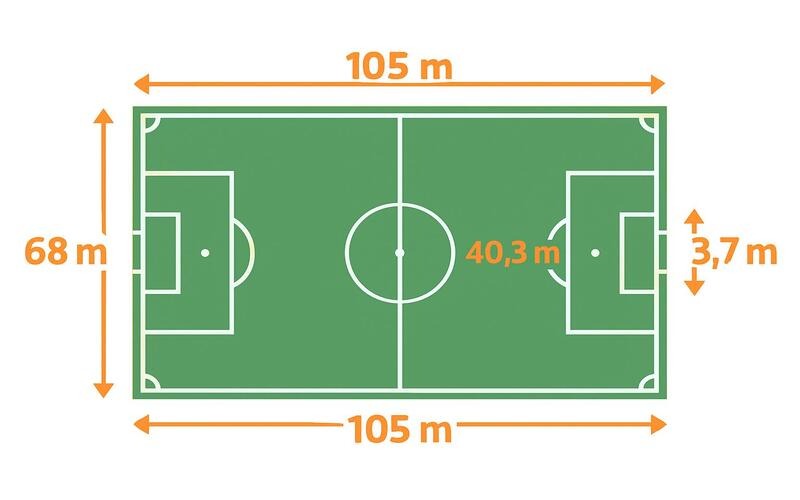
According to the Laws of the Game issued by IFAB, an 11-a-side football pitch is rectangular, with the length required to be greater than the width. For ordinary matches, the length of the touchline ranges from 90 to 120 m, while the width of the goal line ranges from 45 to 90 m.
For international matches, the limits are narrower. The pitch length ranges from 100 to 110 m, while the width ranges from 64 to 75 m. This is the range applied to professional international playing fields.
A commonly used size at high-level stadiums is 105 x 68 m. However, not every professional pitch is required to have exactly these dimensions as long as it remains within the limits permitted by the Laws of the Game.
People who regularly follow 90phut may notice that football pitches at major competitions often have fairly similar proportions. This helps players adapt more easily when competing in different countries or tournaments.
Football Pitch Length and Width
The two most basic measurements used to determine pitch dimensions are length and width. The touchline is always longer than the goal line, creating the characteristic rectangular shape of a football pitch.
On professional playing fields, the dimensions are usually selected based on competition requirements, available space, and playing style. A pitch with greater width can provide more operating space on both wings, while a narrower pitch often brings the lines of play closer together.
For spectators following lịch bóng đá, differences in pitch dimensions can sometimes also affect how a team implements its tactics. Teams that prefer possession and exploiting the width of the field often have an advantage when playing on a wider pitch.
How Is the Goal Area Regulated?
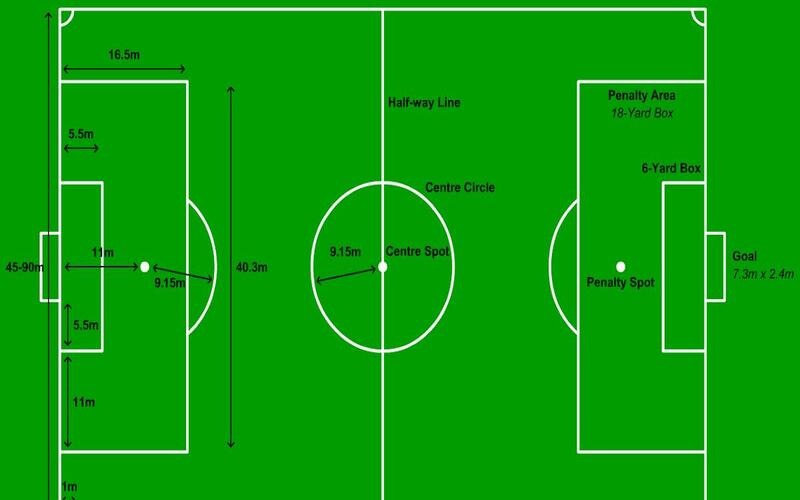
The goal area, also known as the 5.5-meter area, is located directly in front of the goal. From each goalpost, two lines perpendicular to the goal line are drawn into the field for a distance of 5.5 m. The ends of these lines are connected by a line parallel to the goal line.
This area has an important role in many match situations. Goalkeepers are granted certain rights within the goal area, while it is also a place where close-range challenges frequently occur near the goal.
When watching 90Phut TV, fans can clearly observe the goal area during corner kicks, crosses, or close-range finishing situations.
What Are the Dimensions of the Penalty Area?
The penalty area is one of the most important zones on the pitch. From each goalpost, two lines perpendicular to the goal line are drawn 16.5 m into the field. These two lines are connected by a line parallel to the goal line.
The penalty mark is located 11 m from the midpoint between the two goalposts. This is the position from which penalty kicks are taken when the defending team commits a sufficiently serious offense inside the penalty area.
The penalty arc is drawn outside the penalty area with the penalty mark as its center. This structure helps referees determine the position of players during penalty-kick situations.
Matches updated on 90 Phút TV frequently feature penalty situations that determine the result. Therefore, understanding the structure of this area helps viewers follow what happens on the pitch more easily.
Standard Football Goal Dimensions
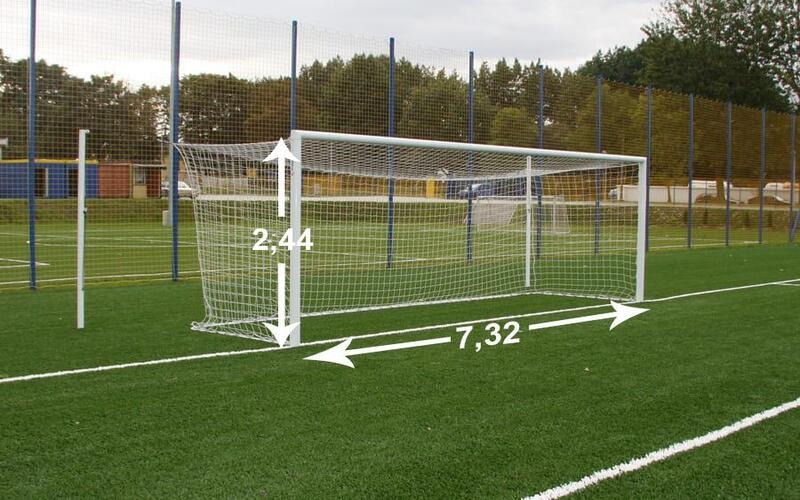
The goal is positioned in the center of each goal line. The distance between the two goalposts is 7.32 m, while the height from the bottom edge of the crossbar to the ground is 2.44 m.
The two goalposts and the crossbar must have an appropriate shape and be designed to ensure player safety. A net is usually attached behind the goal to retain the ball after successful shots.
The ratio between the goal’s width and height has long been standardized. As a result, goalkeepers competing in different tournaments can become familiar with the same standard.
People following 90m TV may notice that goal dimensions are almost unchanged whether a match takes place in the Premier League, Champions League, or international competitions.
Center Circle and Kick-Off Point
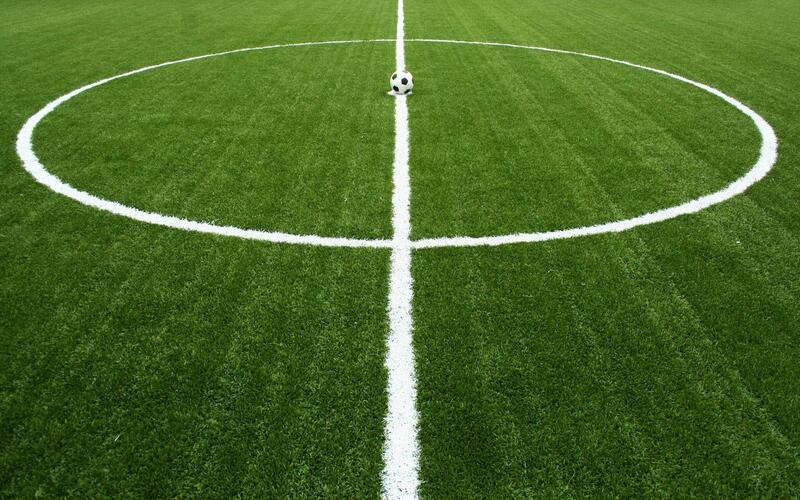
The center circle has a radius of 9.15 m measured from the center spot. The center spot is where the kick-off is taken at the beginning of the match, the second half, and after every goal.
The dimensions of the circle help determine the minimum distance that players from the team not taking the kick-off must maintain when the match begins or resumes after a goal.
The halfway line divides the pitch into two equal halves. It also serves as a reference for determining player positions in many tactical situations.
When following 90P TV, viewers can easily identify the center circle during kick-offs at the beginning of the match or after a team has just scored.
Pitch Markings Must Have Consistent Dimensions
All pitch markings belong to the areas they define. According to the Laws of the Game, the markings must have the same width and must not exceed 12 cm.
The touchlines and goal lines are the most important boundary markings. If the ball completely crosses a boundary line, it is considered out of play.
Other markings, such as the halfway line, center circle, penalty-area lines, and corner arcs, each have their own functions. Accurate pitch markings help referees make consistent decisions.
This is also why, when constructing a playing field, investors need to strictly comply with Standard football pitch dimensions rather than simply estimating them by eye.
How Do Pitch Dimensions Affect Tactics?
The playing area’s size directly affects how a team implements its tactics. A wide pitch creates more space between players, especially in the two wide channels. This suits teams that are capable of controlling possession and frequently use wingers.
Conversely, a pitch with a smaller width reduces the distance between the lines. The defending team can maintain its defensive shape more easily while limiting the opponent’s operating space.
People who regularly follow lịch bóng đá may notice that some teams perform more effectively at home because they are familiar with the pitch and playing space. However, pitch dimensions are only one of many factors that influence results.
Football Pitch Standards for International Matches
At international level, football pitches must meet stricter requirements regarding dimensions and infrastructure. FIFA and relevant football organizations generally establish specific standards to ensure that matches take place under appropriate conditions.
The 105 x 68 m dimensions are very commonly used at large stadiums. This size provides a balance between attacking space, defensive capabilities, and tactical requirements.
In addition to pitch dimensions, factors such as grass quality, drainage systems, lighting, stands, and technical areas also play important roles.
The content on 90 Phut often helps fans access many matches held at stadiums that meet high standards.
7-a-Side and 5-a-Side Football Pitch Dimensions
In addition to 11-a-side pitches, amateur football commonly features 7-a-side and 5-a-side pitches. These two types of pitches are smaller to suit the number of players and available playing space.
7-a-side pitches are commonly used for amateur tournaments, schools, and sports centers. Their actual dimensions can vary depending on the regulations of each competition, but they are generally much smaller than 11-a-side pitches.
5-a-side pitches are even smaller, making them suitable for fast-paced play with limited space and requiring players to control the ball within tight areas.
When following 90Phut, fans can easily recognize the differences between 11-a-side football and other forms of amateur football. Each type of pitch creates its own pace and tactical requirements.
Conclusion
Standard football pitch dimensions are established based on a system of regulations designed to ensure fairness, safety, and suitability for tactical play. For 11-a-side pitches, international matches generally use a length of 100–110 m and a width of 64–75 m, with 105 x 68 m being a very common specification.
When watching football through 90p TV, understanding these measurements helps viewers better visualize the playing space. At the same time, keeping up with lịch bóng đá allows fans to proactively choose exciting matches to watch.
Read more related blogs on Instagram Bio Style Generator. Also join WhatsApp for more update.