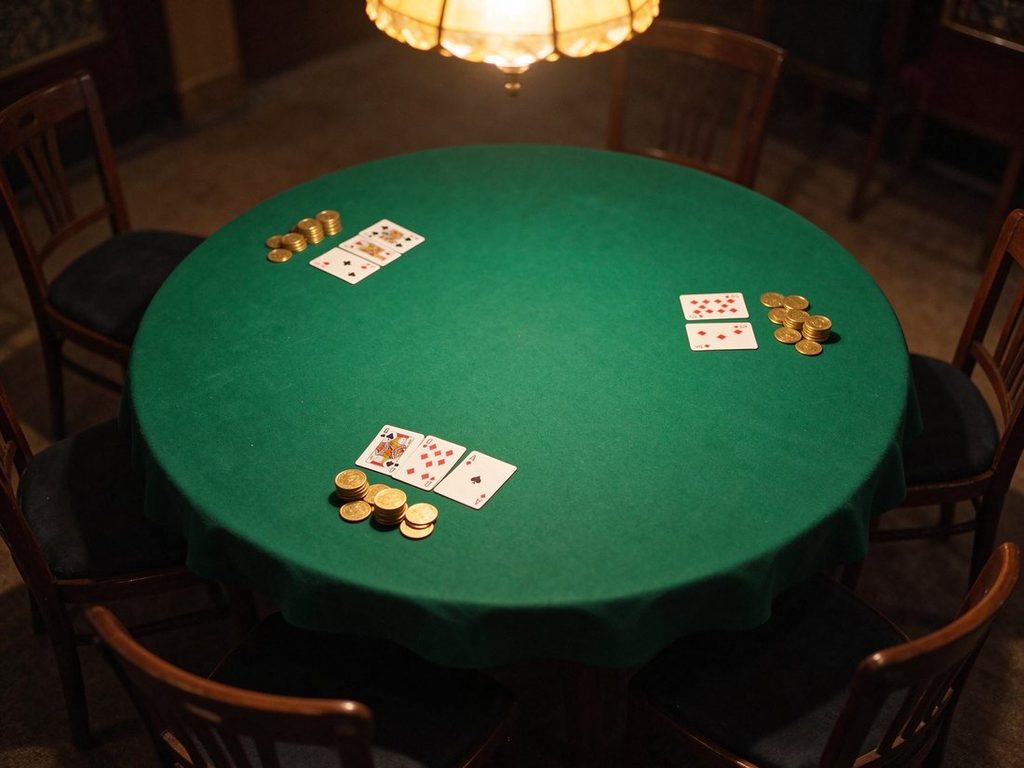
Table size changes Teen Patti more than the cards do. At a three-player table you win a much larger share of pots but face deeper stacks relative to the boot; at a six-player table a trail is rarer in the sense that someone else may hold it, and folding correctly becomes the main skill. The practical rule is to reduce bluffing and raise your calling standard as the table grows, and to reverse both at a short table. Below is the arithmetic behind that rule, with the hand distribution, the fold-frequency differences and a worked comparison of the same hand at both table sizes.
The Distribution Is Fixed; the Competition Is Not
Your chance of being dealt each hand category does not depend on the number of players. The table below uses the standard 52-card Teen Patti deck, 22,100 possible three-card hands, and the classic hand order. These figures are the base every other calculation in this guide stands on.
| Hand | Combinations | Chance of being dealt it | Roughly one in |
| Trail (three of a kind) | 52 | 0.24% | 425 hands |
| Pure Sequence | 48 | 0.22% | 460 hands |
| Sequence (mixed suits) | 720 | 3.26% | 31 hands |
| Colour (same suit, not in order) | 1,096 | 4.96% | 20 hands |
| Pair | 3,744 | 16.94% | 6 hands |
| High Card | 16,440 | 74.39% | 1.3 hands |
What changes with table size is how likely it is that someone else holds a better hand than yours. With four opponents instead of two, the chance that at least one of them holds a Pair or better roughly doubles for a given holding. This is the whole reason a Pair of Kings feels strong heads up and ordinary at a full table.
Three-Player Tables: Where Bluffs and Thin Calls Live
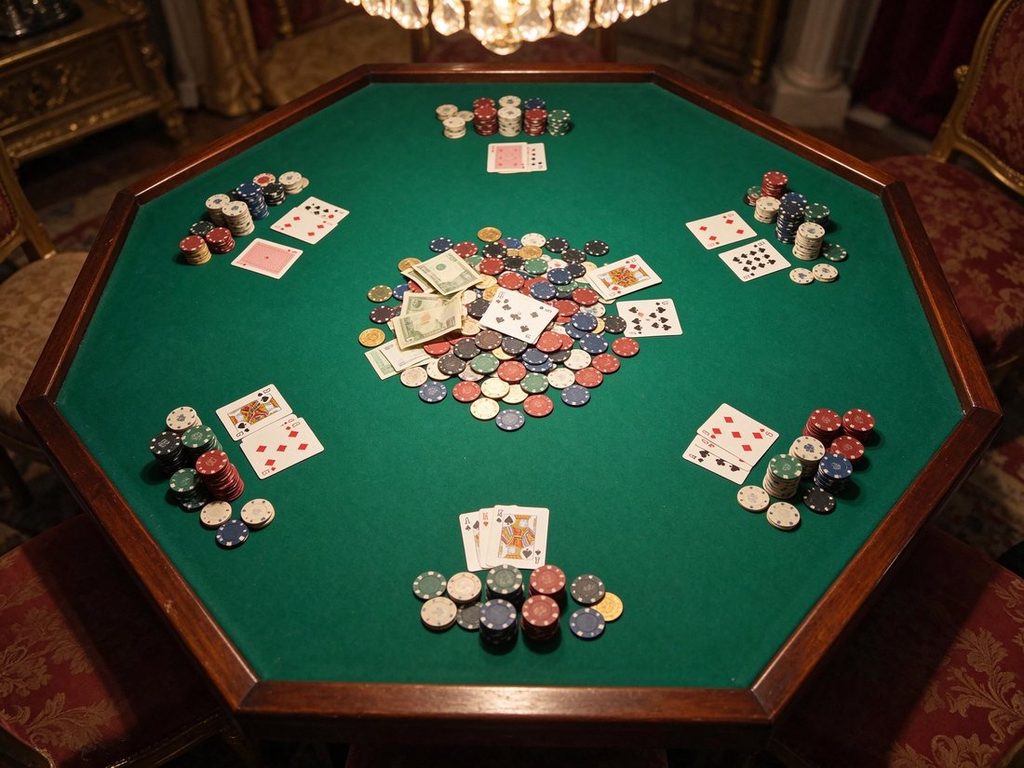
At a three-player table the average pot is contested by fewer hands, so the boot is a larger share of the pot and the pot grows more slowly per round. Two consequences follow.
First, a raise folds the field with less risk than at a full table, because there are fewer independent hands that can call. A single raise from a blind position with no pair still shows a profit if opponents fold more than about 35 percent of the time, which is common when only one player remains. Second, thin calls become viable: a low Pair can be called against a single opponent for a modest amount, because the chance that opponent holds a better Pair is far lower than at a six-player table.
The failure mode at a short table is over-bluffing the same two opponents. Once a player has called your last three raises, the fourth is a donation. Rotate the pressure instead: raise the player who has been folding, call the one who has been calling, and keep the third opponent out of the pot if possible.
Six-Player Tables: Where Discipline Pays
At a six-player table the opposite holds. The percentages quoted below are approximations derived from the base distribution, not exact equities, because they ignore folding and the specific ranks you hold. With five opponents, the chance that none of them holds a Pair or better when you hold High Card is small: roughly 0.744 raised to the fifth power, or about 22 percent, so you are beaten about 78 percent of the time before any betting starts. That number is the reason a High Card hand is a fold at a full table regardless of what the table chat says.
| Your hand | Approx. chance you are best at a 3-player table | Approx. chance you are best at a 6-player table | Default line |
| Trail | Over 99% | Around 98% | Raise for value at both |
| Pure Sequence | Around 98% | Around 92% | Raise, then re-evaluate if raised |
| Sequence | Around 95% | Around 80% | Call at short, call selectively at full |
| Colour | Around 90% | Around 65% | Call at short, tighten at full |
| Pair | Around 70% | Around 35% | Raise at short, call only if cheap at full |
| High Card | Around 40% | Around 15% | Fold at full; bluff only from blind, short-handed |
The Same Hand at Both Table Sizes
You hold a Pair of Queens with a Nine kicker. Stake 20, boot 20, five players seated in one case, two in the other.
Six players. Three players fold at the boot. One raises to 40, you call, pot 160. He raises again to 80 and the pot is 240. Your Pair of Queens beats any Pair below Queens and loses to Kings, Aces, Sequences, Colours, Pure Sequences and Trails. Against one opponent who has raised twice at a full table, that range is likely to include a high Pair or a Sequence, so the correct action is to fold. Calling 80 to chase a 240 pot with a hand that beats only the lower half of the Pair group is a losing habit repeated over hundreds of hands.
Three players. One folds, leaving you and one opponent, pot 60. He raises to 40, you call, pot 140. He raises to 80, pot 220. Here the same Pair of Queens is often the best hand: the opponent’s second raise is affordable for him and his range includes bluffs, because pressure is cheap at a short table. Calling 80 into 220, needing about 27 percent equity, is defensible. The difference in the answer is not in the cards but in the number of opponents and the price of the call.
Where the anchors sit. Learning this adjustment on one teen patti master table is not enough, because table size and stake step interact; the teen patti ranking stays fixed while the value of a middle hand swings between the two formats.
Adjustments to Carry Between Formats
Four adjustments cover most of the gap between short and full tables. Reduce bluff frequency by about half when moving from three to six players, because each extra opponent is an additional caller. Raise your calling standard by one hand category at a full table: a Sequence that would be a raise short-handed becomes a call. Expect larger pots per hand at a full table, so a buy-in that lasts 40 hands at three players may last only 20 at six. And watch position relative to the boot: acting last in a full pot is worth more than acting last at a short table, because more information arrives before your decision.
Risk Notes
Table size changes the shape of results, not their direction: a good adjustment reduces the cost of bad calls, it does not produce guaranteed wins. Virtual chips in practice rooms carry no cash value; where real-money play exists, local law and platform terms decide whether participation is permitted, and stake levels are not a substitute for a loss cap. Keep account credentials private and treat unsolicited messages offering guaranteed returns or remote support as impersonation.
The Takeaway
The hand distribution is fixed at 0.24 percent for a Trail and 74 percent for High Card, but the chance that you are best changes sharply with the number of opponents. At three players, bluff more and call thinner. At six, fold High Card without hesitation, treat a low Pair as marginal, and cut your bluff frequency in half. The same Pair of Queens is a fold at a full table and a call at a short one, and understanding why is the difference between using the format and being used by it.
Read more related blogs on Instagram Bio Style Generator. Also join WhatsApp for more update.